Custom Software vs Ready-Made Software: Which Is Better for Small Businesses?
For small businesses, ready-made software is better if you need an immediate, budget-friendly solution for standard tasks like basic accounting or general CRM. However, custom software is superior if your business relies on unique workflows, requires seamless integration across existing tools, or plans to scale rapidly without paying recurring per-user subscription fees. Custom solutions build long-term digital equity and fit your business processes precisely.
What Will You Learn in This Software Comparison Guide?
Choosing the right digital infrastructure is one of the most critical decisions a small business owner can make. Selecting the wrong software model can lead to operational bottlenecks, expensive migration costs, and unnecessary subscription fees as your company expands.
In this comprehensive guide, you will learn the core differences between custom-built applications and commercial off-the-shelf (COTS) software, evaluate total cost of ownership (TCO), compare security and scalability factors, and discover which approach aligns best with your business goals.
What Key Differences Distinguish Custom Software from Ready-Made Software?
Understanding the structural differences between tailored systems and off-the-shelf platforms helps you make an informed investment.
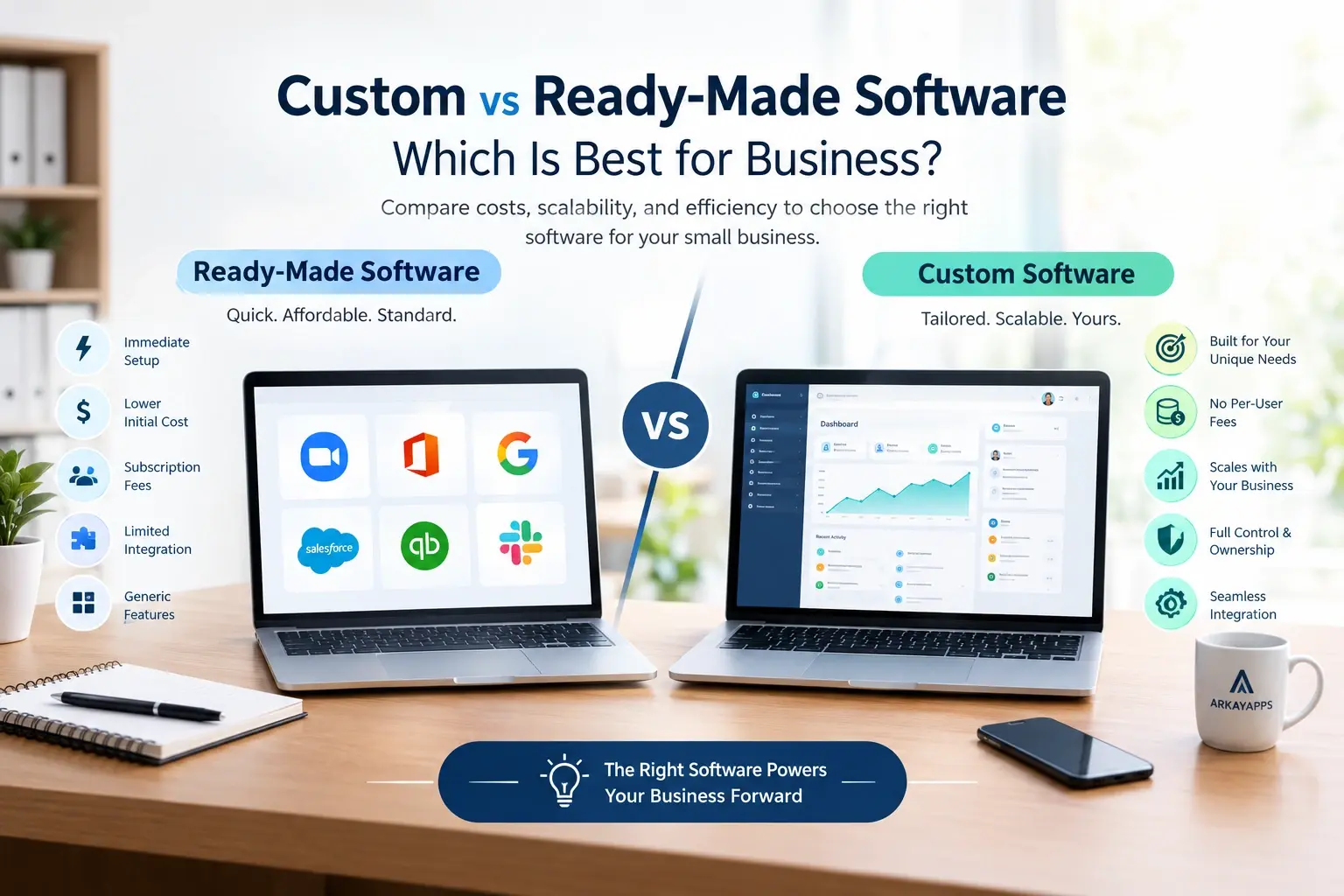
- Tailored Functionality: Custom software is built from scratch around your specific business operations. Ready-made software offers generalized features designed to satisfy a broad market, often including unused clutter.
- Upfront vs. Long-Term Costs: Off-the-shelf tools have lower initial setup costs but carry monthly per-user licensing fees. Custom applications require higher upfront development capital but eliminate ongoing user subscription fees.
- Control & Ownership: With custom software, you own 100% of the source code and intellectual property. Off-the-shelf software vendors own the platform, meaning you must adapt to their feature changes, pricing hikes, or service shutdowns.
- Integration Flexibility: Custom applications integrate smoothly with your existing databases, APIs, and internal tools. Ready-made platforms often restrict third-party integrations or require expensive middleware.
To explore tailored digital solutions designed specifically around your operational workflow, check out the services on the Arkay Apps.
Custom vs Ready-Made Software: Practical Comparison Table
Review the side-by-side comparison below to see how both software approaches perform across vital business metrics:
| Evaluation Metric | Custom Software Solutions | Ready-Made (COTS) Software |
|---|---|---|
| Initial Time-to-Market | Longer; requires strategic design, coding, and testing. | Immediate; download and start configuring within hours. |
| Upfront Capital Required | Higher initial investment. | Low initial setup and onboarding cost. |
| Ongoing Licensing Fees | None; zero per-user monthly subscription costs. | High long-term operational expense via monthly or annual fees. |
| Scalability & Adaptability | Unlimited; expand features anytime your business grows. | Limited by vendor roadmaps and tier-based restrictions. |
| Competitive Advantage | High; unique features set your business apart. | None; competitors have access to the exact same software tools. |
| Maintenance & Support | Dedicated support from your custom engineering team. | Dependent on vendor customer support ticket queues. |
To understand how custom web engineering elevates overall operational efficiency, explore our specialized Arkay Apps Custom Software Development Services.
How Do You Calculate the Total Cost of Ownership (TCO)?
Small business leaders often choose ready-made software because of its low entry price, but financial analysis reveals a different long-term story.
- Hidden SaaS Scaling Costs: A ready-made CRM costing 40 per user per month seems affordable for 3 staff members (1,440/year). However, as your team grows to 25 employees, that annual subscription jumps to $12,000 every year indefinitely.
- Workaround Efficiency Losses: When off-the-shelf software lacks a vital workflow feature, staff spend hours manually copying data between spreadsheets, leading to paid labor inefficiency.
- Long-Term Custom Equity: Custom software acts as a valuable company asset. Once developed, running costs are limited to standard server hosting and periodic maintenance.
If you want to turn complex operational ideas into clear execution blueprints, learn more about our Arkay Apps Idea Visualization Process.
Which Software Approach Is Right for Your Small Business?
Choosing between these two models depends on where your business currently sits in its growth trajectory.
- Choose Ready-Made Software If: You are a newly launched startup, need standard accounting or email marketing tools immediately, have a tiny upfront budget, and operate using universal industry processes.
- Choose Custom Software If: Your business relies on proprietary operational methods, requires seamless integration with existing internal platforms, handles sensitive data, or seeks to scale without recurring subscription burdens.
To see real-world client implementations, successful application builds, and digital transformations, review the Arkay Apps Portfolio & Case Studies.
Frequently Asked Questions
Is custom software too expensive for small businesses?
Not necessarily. While initial custom development requires a higher upfront budget than a monthly subscription, custom software often costs significantly less over a 3-to-5-year period because you eliminate per-user licensing fees and gain efficiency through tailored automation.
How long does it take to build a custom software application?
Development timelines vary depending on project complexity. A streamlined custom web or mobile application generally takes between 8 to 16 weeks from initial design architecture to final deployment and testing.
Can custom software be integrated with my existing tools?
Yes. Custom software is engineered specifically to connect with your existing databases, third-party payment gateways, CRM systems, and legacy tools via custom APIs, ensuring smooth data flow across your business.
What happens if our business processes change after launching custom software?
Custom applications are inherently flexible. Unlike ready-made platforms where you must wait for the vendor to release updates, custom software allows your developer team to add, modify, or scale features whenever your operational needs evolve.
Key Takeaways for Making Your Software Decision
Deciding between custom software and ready-made solutions comes down to balancing immediate budget constraints against long-term strategic flexibility. While off-the-shelf software offers a quick fix for general tasks, custom software gives growing small businesses a distinct competitive edge, complete operational ownership, and seamless long-term scalability. Evaluate your 3-year growth plan today to choose the software foundation that powers your business forward!